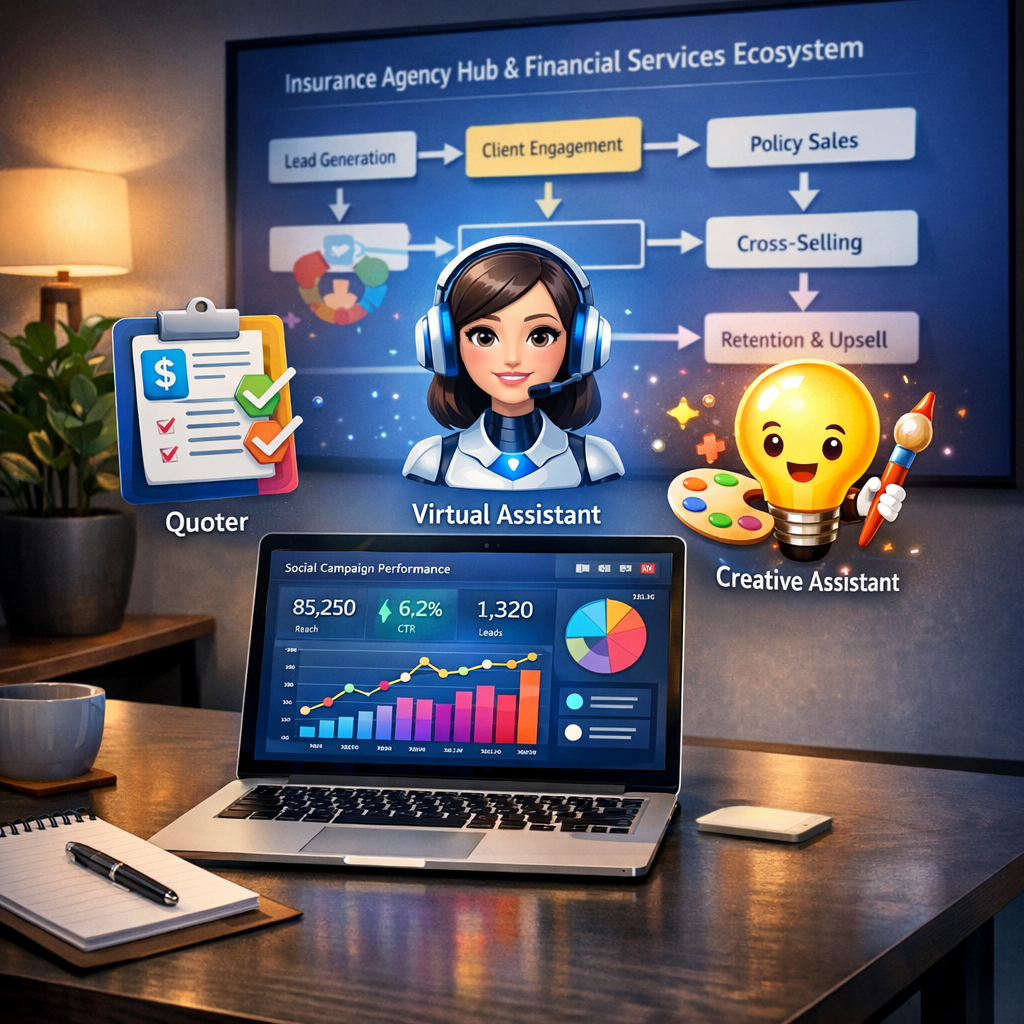
The Autonomous Insurance Ecosystem: Q.V.C.™ Model & Event‑Driven Database Synchronization
A tactical breakdown of the Q.V.C.™ (Quoter, Virtual Assistant, Creative) model and event-driven database synchronization between our primary insurance hub and the centralized financial services ecosystem.
In highly competitive, high-stakes consumer verticals like auto, home, and commercial insurance, traditional marketing is flatlining. The standard industry playbook—buying cold, recycled leads from third-party aggregators or running un-optimized Meta "Traffic" campaigns—has transformed from an acquisition mechanism into a direct balance-sheet drain.
When you buy a cold insurance lead, you aren't buying an exclusive customer; you are purchasing a ticket to a high-friction race. You compete with 5 to 7 other brokers dialing the same prospect within 30 seconds. This transactional, volume-chasing approach burns your staff, degrades your brand reputation, and operates on terrible unit economics.
The winners of this era are abandoning transactional lists to build autonomous community ecosystems. This guide breaks down the exact architectural, direct-response blueprint to replace outdated lead models with a Social Media Store Front™ powered by White Glove Service™ and the Q.V.C.™ (Quoter, Virtual Assistant, Creative) operational framework.
"If your customer acquisition strategy depends on buying lists, you do not own a marketing pipeline. You own a high-risk telephone sprint. True scale belongs to firms that own their communications and build localized trust."
1. The Unit Economics of the New Agency Model
To understand why traditional acquisition structures are failing, we must analyze the stark contrast in unit economics between standard lead-buying models and a unified community ecosystem model.
| Performance Metric | Traditional Agency Model | High-Performance Ecosystem Model |
|---|---|---|
| Lead Acquisition Source | Third-Party Lead Brokers & Bulk Databases | Organic Social Media Store Fronts™ & Trusted Referrals |
| Average Cost Per Lead (CPL) | 45−45−120 (Highly volatile) | 12−12−35 (Calibrated organic/local mix) |
| Lead-to-Quote Conversion | 8% - 15% (High friction & fake phone numbers) | 45% - 62% (Empathy-driven warm handoffs) |
| Policy Bundling Rate (Cross-Sell) | Low (Single-policy transactional focus) | High (Multi-policy bundling across home, auto, life) |
| Annual Retain / Retention Rate | 68% - 74% (Price-sensitive shoppers) | 88% - 94% (High-affinity brand loyalists) |
By shifting your operational focus from transactional volume to relationship-driven conversion, you lower your baseline Customer Acquisition Cost (CAC) while scaling your long-term Customer Lifetime Value (LTV).
2. The Social Media Store Front™ and the Q.V.C.™ Engine
Most insurance and financial firms view social media as a billboard to post generic company updates and corporate stock images. In our client's model, we treat every social channel as an active digital storefront operated by our dedicated team.
Whether a prospect is browsing Facebook groups in Maryland, watching short-form educational videos on TikTok, or asking for local recommendations on Nextdoor, they are encountering a highly optimized, localized storefront designed to initiate conversations. This system is driven by our Q.V.C.™ (Quoter, Virtual Assistant, Creative) framework:
The Quoter / Product Assistant (Q)
The Quoter is the technical processing layer. Rather than forcing prospects into long, multi-step web forms on day one, the Quoter acts as an interactive concierge. It delivers rapid, compliant quotes and coverage reviews directly within messaging chats (WhatsApp, WeChat, Facebook Messenger, Zalo). It uncovers immediate cross-sell and up-sell opportunities (e.g., bundling auto with renters or umbrella policies) while maintaining absolute regulatory compliance.
The Virtual Assistant (V)
The Virtual Assistant manages the engagement flow. Operating 24/7/365, it monitors every comment, direct message, and mention across our social fronts. It qualifies intent, handles standard FAQs, schedules appointments natively in GHL, and executes immediate, high-trust follow-ups. Prospects aren't routed to a sterile form; they are welcomed by a human-centric conversational flow.
The Creative Assistant (C)
The Creative Assistant is the authority builder. It produces localized, educational, and high-value bilingual content tailored to specific immigrant and ethnic communities across our core operating regions: Maryland, Virginia, Washington D.C., Pennsylvania, North Carolina, and Ohio. It translates complex policy mechanics into digital storytelling that addresses actual regional concerns, turning likes into warm client inquiries.
3. Cross-Sell Architecture: Linking the Insurance Hub and Financial Ecosystem
The true power of this model lies in the seamless, event-driven integration between our two core web environments: The Primary Insurance Agency Hub and The Centralized Financial Ecosystem Hub.
When a homeowner lands on the primary insurance agency hub to protect their property, they aren't isolated in an insurance silo. Our CRM database structure uses real-time webhooks (via n8n or Make.com) to evaluate their profile. If the data indicates they are purchasing a new home, the system automatically triggers a cross-sell pipeline. It routes their contact payload to the financial services ecosystem hub, matching them with local mortgage and refinancing solutions, tax preparation, or long-term financial planning.
This bidirectional flow is governed by structured custom schema mapping inside our GoHighLevel CRM:
{ "client_id": "client_90281_dmv", "source_platform": "primary-insurance-hub", "active_policy": "Homeowners_Insurance", "life_event_trigger": "New_Property_Purchase", "target_destination": "financial-ecosystem-hub/mortgage-solutions", "assignment_routing": "Regional_Mortgage_Advisor_Queue", "nurture_state": "Enrolled_in_Homebuyer_Educational_Drip" }
This unified model ensures that every service interaction naturally converts into future business opportunities across all our financial products and partner brands.
4. The White Glove Service Journey: Elevating Intake to Conversion
Traditional service operations treat support calls (like address updates, billing questions, or claims) as expense centers. In our White Glove Service™ model, every service call is a high-trust revenue opportunity. We train and compensate our representatives to navigate our 7-step customer journey with extreme care:
01. Service Intake & Client Reconnect — Build immediate rapport, confirm the client's policy details, and handle their initial service request with absolute speed and accuracy.
02. Needs Discovery (Micro-Review) — Ask layered, open-ended questions about their life to uncover recent triggers (e.g., purchasing a new vehicle, starting a business, or home renovations).
03. Policy Health Check (Value Reframe) — Review active coverage limits and deductibles, locate missing discounts (like home/auto bundling), and educate them on their current risk profile.
04. Solution Delivery — Execute the initial request perfectly, then present good/better/best options to optimize their coverage and increase AOV.
05. Confirmation & Expectation Setting — Clear up any confusion, explain processing times, and ensure the client feels 100% confident in their policy state.
06. Extra Mile Experience (Temperature Check) — Actively listen to their emotional tone. Ask: "How was your experience today? Did we meet your expectations?"
07. Monetization Moment — If and only if the client's "temperature check" is green, the representative moves to collect a Google Review, ask for localized referrals, or pitch our cross-sell bundles.
This structured approach guarantees that we protect our existing book of business while organically scaling our client base through high-value referrals and community trust.
Technical Q&A for Search & Crawl Indexing
Q: How does GoHighLevel's CRM state architecture handle lead routing between multiple brand platforms?
A: GHL leverages event-driven custom fields and webhook triggers. When a lead submission is registered on the primary insurance hub, the system parses the metadata payload (evaluating geographical region, product intent, and ethnic community tags). If a financial or mortgage cross-sell trigger is detected, n8n executes a secure API call to sync the record to the financial ecosystem's dedicated pipeline. This ensures zero data latency and maintains complete tracking attribution from the initial social click down to the finalized policy contract.
Q: How do you optimize multi-language ad campaigns for ethnic and immigrant communities in the DMV area?
A: We run localized geofencing combined with strict language-match copy. Instead of simple automated translations, we write culturally relevant, educational content that respects the specific financial realities of each community. Ads are paired with local landing pages containing bilingual trust elements, licensed advisor credentials, and localized social proof. This localized, high-trust architecture drops standard acquisition costs by up to 40%.
Q: What is the risk of utilizing unaligned DNS settings on CRM automated email campaigns?
A: Unaligned DNS setups trigger instant spam blocks. Corporate networks and spam engines (like Barracuda or Microsoft Defender) verify that your Header From domain matches the cryptographic signatures authorized in your SPF and DKIM records. If these records are unaligned, your automated GHL reminders, quote deliveries, and referral nurtures will land in quarantine or spam folders. We resolve this by configuring strict subdomain structures aligned to dedicated, warmed email servers.
Stop Buying Leads. Build a Self-Sorting System.
The traditional insurance agency model is dead. To scale in competitive metropolitan areas like Maryland, D.C., and Virginia, you must own your communications, build localized community trust, and link your service and sales funnels into a single, automated operating system.